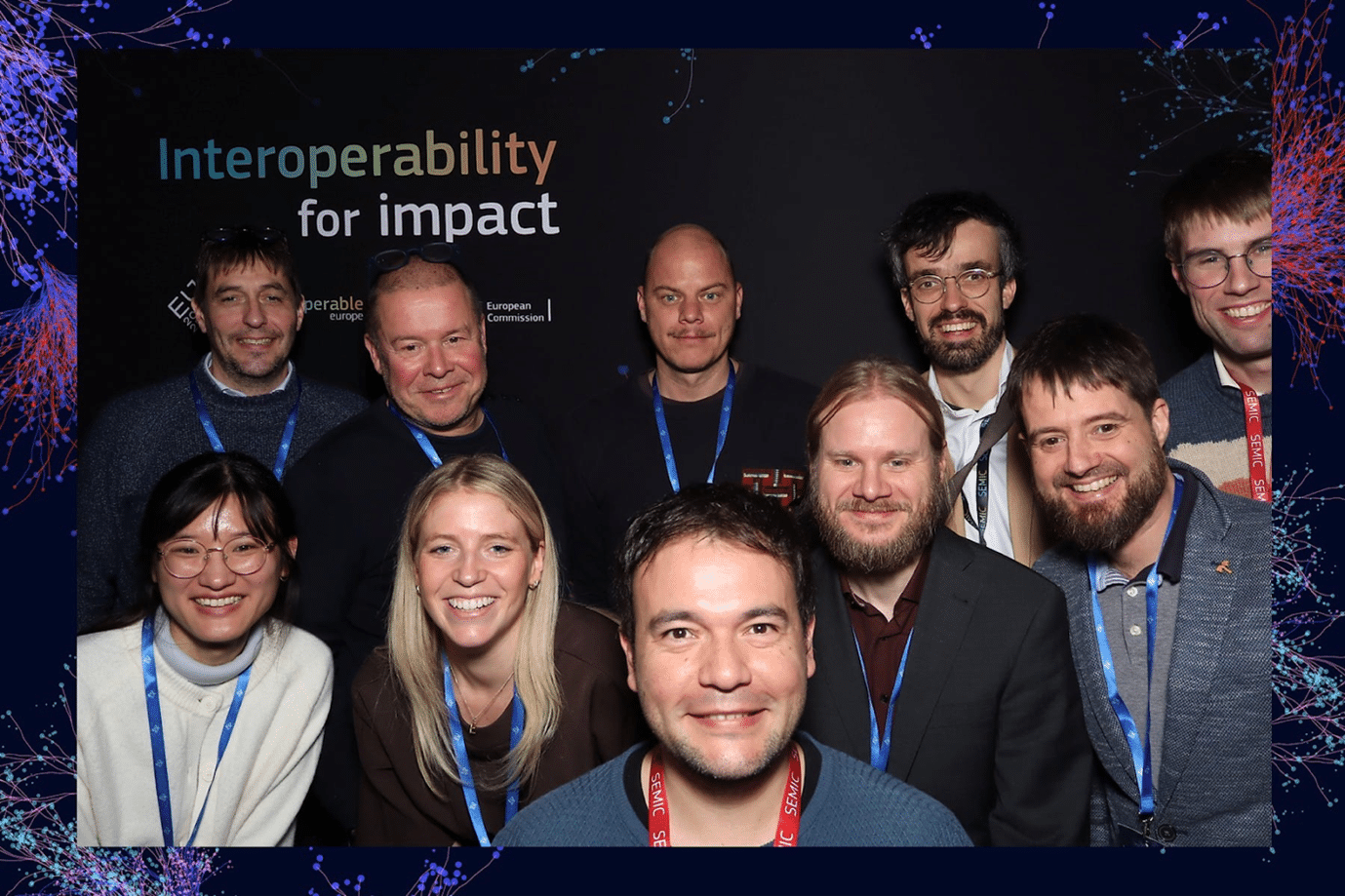
At the end of November 2025, Gert De Tant and I – Brecht, Linked Data expert at Sirus – had the pleasure of speaking at the Linked Data Event Streams (LDES) workshop during the SEMIC Conference in Copenhagen. As long-time believers in the power of LDES, we were excited to share hands-on insights about how this technology can unlock real business value.
For those who couldn’t attend, this blog post highlights the essence of our talk—along with some of my key takeaways from the broader (LDES) sessions at SEMIC.

LDES as a Business Enabler
Tackling societal challenges
Many Flemish cities face growing challenges in the water domain. Roeselare aims to reduce the impact of flooding; Brugge wants to enhance the water quality of its iconic canals for swimmers. Addressing such issues requires high-quality, real-time water data streams. We showcased how we supported Aquafin—one of the Flemish organizations managing sewer systems—in publishing their overflow data as LDES. We also built LDES consumption pipelines that showcase the overflow events: blueportal.aquafin.be/home. This is LDES in action: enabling transparent, reusable, real-time data for societal benefit.
Stimulating innovation
LDES enables a generic and scalable way to onboard data sources into data platforms, especially when combined with innovative pipeline tools like RDF Connect. Within the Urban Sense platform, LDES is supported as input data source and this opens the door to other existing integrations, such as AI prediction models. One example is the RAINBRAIN project, where water levels are predicted to notify users proactively—empowering them to take timely safety measures.
Improving services
We see LDES as the first interface any data publisher should maintain. Once the LDES feed exists, it becomes easy to build multiple additional APIs and services on top—using Docker—to fuel real-world applications: websites, route planners, brochures, and more. A success story is Westtoer, a Flemish tourism organization and early adopter of LDES. Their feeds are already being reused by cities, local tourism offices, museums, and others—showing the flexibility and interoperability LDES brings.

Conference Takeaways: What’s New in the LDES Ecosystem?
LDES 1.0 is here
After years as a living specification, LDES has reached its first stable release. This milestone will accelerate truly interoperable implementations—both servers and clients—across the ecosystem.
Vocbench meets LDES
Vocbench, a widely used tool for managing SKOS codelists, is now exploring how to publish LDES out-of-the-box. This is particularly promising for projects like DECIDE (DS4SSCC), where codelists need to be integrated into triple stores and leveraged by AI models.
data.europa.eu embraces LDES
The EU Publication Office shared early insights on using LDES to integrate DCAT metadata from member states. The emerging LDES DCAT-AP feed could become a powerful new mechanism for metadata exchange across Europe.
A new .NET LDES server
Thanks to Ranko Orlic’s enthusiasm, the community now has ldes-server.NET—a fully LDES-compliant server built in .NET. A free community edition is available, alongside a more feature-rich production version: github.com/rorlic/ldes-server.net
Jelly: high-speed streaming for Linked Data
Piotr Sowiński presented Jelly, a new format designed to significantly accelerate the streaming of Linked Data. While its place within the LDES vision is still taking shape, it’s definitely something to watch.
AI and semantics: a growing symbiosis
A recurring theme this year was the interaction between semantics and AI. Examples include:
- Entity linking
- Text-to-SPARQL generation
- Aligning related concepts
- Semantic enrichment
What is LDES again?
Linked Data Event Streams (LDES) is an initiative that helps data publishers strike the right balance between traditional APIs and static data dumps. LDES allows publishers to release data incrementally, scalably, and in a Linked Data-friendly format.
More details can be found in the official specification: w3id.org/ldes/specification
If you want help implementing LDES, exploring LDES-powered architectures, or integrating it with AI and data platforms, feel free to reach out!