Is your IBP (Informatie beheersplan) on point?
City and town governments face increasing challenges in managing their data effectively while ensuring compliance with legal regulations. Enter the IBP – a crucial method for keeping your information in check and meeting both federal and Flemish government requirements.
What is an IBP?
The IBP, short for Informatiebeheersplan, is a framework created by the Flemish and federal governments to help local governments manage their data. The IBP ensures that all information is regularized, including aspects such as purpose, retention periods (how long may information be kept?), and disclosure of information.
While the Flemish and federal governments are obligated to manage information following specific legal guidelines, local governments face slightly less stringent legal requirements. Nevertheless, they are already required to organize their work into series. These series serve as the overarching structure for managing the files and records of the local government in question. Each series in the IBP is assigned specific metadata that covers aspects like purpose, retention periods, and information sensitivity. This metadata is automatically applied to the files and records categorized within the series.
How can Sirus help with setting up your IBP?
Not only do we provide expertise in architectural design and implementation of your IBP in SharePoint, we also look at the specific needs of your city or town. Our goal is to ensure that your IBP goes beyond just a technical fix—it becomes a practical, user-friendly system that meets legal requirements and is easy to maintain and search.
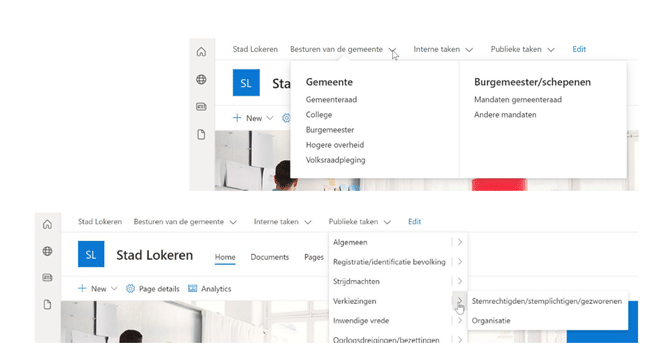
A future-proof design
When developing your IBP, we often start from the selection list for municipalities, prepared by the VVBAD and approved by Het Rijksarchief. We then supplement this with specifications from the series templates developed by Digital Flanders. By working with a structure based on administrative processes, we make sure your IMP is future-proof.
Align with the Series Registry
Moreover, we make sure that the series established within the IBP align with the Series Registry of the Flemish government (a database in which every series managed by a local authority must be registered, including a number of parameters such as retention period, public access, purpose, information sensitivity…). This registration became mandatory for cities from January 1, 2024.
We will guide you every step of the way: from setting up the IBP structure to guiding the migration of your data to SharePoint Online.
The benefits of an IBP for your town/city
- A significant reduce in errors and manual labor;
- Files can be found more quickly;
- A more standardized and better information management;
Why Sirus?
- Experts in architectural design and implementation of IBP’s;
- Experience in setting up IBP’s for the City of Lokeren;
- Close-knit partnership;
- We’ll guide you every step of the way;
- We’ll make sure your employees know how to navigate and work in the new digital workspace;
- We’ll make adjustments if need be;
- We stand by for support and review of the IBP;
Curious to know how we set up an IBP?
Curious to get to know our M365 Team and the way they work?
Frequently asked questions
What is an IBP (Informatiebeheersplan)?
An IBP is a structured framework that defines how an organization systematically manages, governs, and archives its information and data. It includes policies, roles, metadata standards, retention rules, and governance to ensure consistency, compliance, and future readiness.
Why is an IBP important for public agencies and municipalities in Belgium?
In Belgium (especially in Flanders), governmental bodies are often required to comply with regulations around records management, transparency, and data retention. An IBP helps ensure you meet legal obligations, reduce risk, and maintain data in a sustainable, auditable way.
Who can help me create or implement an IBP in Flanders or Belgium?
You should look for a consultancy with experience in Microsoft 365, records management, and public sector governance. Sirus provides support for drafting and implementing IBPs tailored to local government and public organizations.
What steps are involved in a typical IBP implementation?
A typical IBP project with Sirus would include:
- Assessment of current information flows and systems
- Definition of governance, metadata, retention and classification rules
- Planning migrations or integrations
- Implementation, testing, training and user adoption
- Monitoring, auditing and continuous improvement
How long does it take to implement an IBP?
The timeline depends on the scope, complexity, and state of existing systems. For a medium-sized municipality, it might take a few months. Sirus works with you to define realistic phases and milestones.
Can Sirus assist with training and governance in an IBP project?
Yes. Sirus not only helps implement technical solutions but also supports governance frameworks, change management, user training and ongoing guidance.
Will implementing an IBP integrate with Microsoft 365 tools (SharePoint, Teams, etc.)?
Absolutely. An IBP is most effective when it integrates with Microsoft 365 tools for document storage, collaboration and records management. Sirus ensures that the IBP aligns with your Microsoft 365 ecosystem.
How do metadata standards and classification rules fit into an IBP?
Metadata and classification are core components of an IBP: they help categorize and label documents, define lifecycle rules, enable search and support compliance. The IBP establishes which metadata are mandatory, optional, and how records are grouped.
What are the challenges of maintaining an IBP over time?
Some common challenges are: legacy systems that don’t support required metadata, resistance to change, user adoption, evolving regulations, and integration with new systems. Sirus helps you plan for sustainability and continuous governance.
How much does it cost to develop and implement an IBP?
The cost depends heavily on size, complexity, number of systems to integrate, and training needs. Sirus can provide an estimate tailored to your organization after discussing your current environment and objectives.